
Tire condition
Inspect your tires frequently for tread wear, signs of damage and for foreign objects lodged in the tread. Check the tread depth.
Minimum tread depthThe tread depth should not drop below 0.12 in/3 mm, although, for example, European legislation only specifies a minimum tread depth of 0.063 in/1.6 mm. At tread depths below 0.12 in/3 mm there is an increased risk of high-speed hydroplaning, even when only small amounts of water are present on the road surface.
When winter tires wear down past a tread depth of 0.16 in/4 mm, they become perceptibly less suitable for winter conditions. In the interest of safety, new tires should be installed.
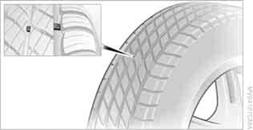
Wear indicators in the base of the tread groove are distributed around the tire's circumference; the letters TWI, for Tread Wear Indicator, on the tire's sidewalls identify tires that incorporate these wear indicators. Once the tire tread has worn down to the wear indicators, the tire has worn to a depth of 0.063 in/1.6 mm.
Wheel/tire damagePlease note that low-profile tires cause wheels, tires and suspension parts to be more susceptible to road hazard and consequential damages.
Unusual vibrations encountered during normal vehicle operation can indicate tire failure or some other vehicle defect. This can, for example, be caused by driving over curbs. The same applies to any other abnormal road behavior, such as pulling severely to the right or left.
 In these cases, reduce speed immediately and
have wheels and tires thoroughly checked. To do so, drive carefully to the nearest
BMW center or tire shop that works according to BMW repair procedures with correspondingly
trained personnel. If necessary, have the vehicle towed there.
Otherwise, tire damage can pose a lethal hazard to vehicle occupants and other road users.
See also:
Fuel cap
Opening
1. Briefly press the rear edge of the fuel filler
flap.
2. Turn the fuel cap counterclockwise.
3. Place the fuel cap in the bracket attached to
the fuel filler flap.
Closing
1. ...
Clock
The settings are stored for the remote control currently in use, refer also to
Personal Profile on page 28.
Setting the timeIn the instrument cluster
To set the 12h/24h format, refer to Se ...
Releasing
With the ignition switched on:
Manual transmission: Press the
switch
while the brake or clutch is pressed.
Automatic transmission: Press the switch while
the brake is pressed or transmission ...