
General driving notes
Closing the trunk lid
 Drive with the trunk lid closed
Only drive with the tailgate closed; otherwise, in the event of an accident or braking or evasive maneuvers, passengers or other road users may be injured or the vehicle may be damaged. In addition, exhaust fumes may enter the passenger compartment.
If driving with the tailgate open cannot be avoided:
- Close all windows and the glass sunroof*.
- Greatly increase the blower speed.
- Drive moderately.
Hot exhaust system
Hot exhaust system
High temperatures are generated in the exhaust system.
Do not remove the heat shields installed and never apply undercoating to them. When driving, standing at idle and while parking, take care to avoid possible contact between the hot exhaust system and any highly flammable materials such as hay, leaves, grass, etc. Such contact could lead to a fire, and with it the risk of serious personal injury as well as property damage.
Do not touch hot exhaust pipes; otherwise, there is the danger of getting burned.
Climate control windshield*
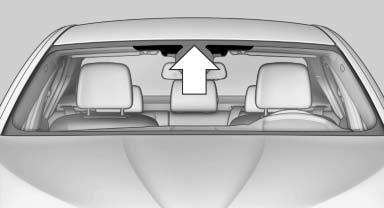
The marked area is not covered with heat reflective coating.
Use this area for garage door openers, devices for electronic toll collection, etc.
Climate control laminated tinted safety glass
The vehicle glass provides full protection against the harmful effects of UV radiation on the skin.
Mobile communication devices in the vehicle
Mobile communication devices in the vehicle
It is advised that you do not use mobile communication devices, e.g., mobile phones, inside the vehicle without connecting them directly to the external antenna. Otherwise, the vehicle electronics and mobile communication devices can interfere with each other. In addition, there is no assurance that the radiation generated during transmission will be discharged from the vehicle interior.
Hydroplaning
On wet or slushy roads, a wedge of water can form between the tires and road surface.
This phenomenon is referred to as hydroplaning. It is characterized by a partial or complete loss of contact between the tires and the road surface, ultimately undermining your ability to steer and brake the vehicle.
Hydroplaning
When driving on wet or slushy roads, reduce your speed to prevent hydroplaning.
Driving through water
Drive though calm water only if it is not deeper than 9.8 inches/25 cm and at this height, no faster than walking speed, up to 6 mph/10 km/h.
Adhere to water depth and speed limitations
Do not exceed this water depth and walking speed; otherwise, the vehicle's engine, the electrical systems and the transmission may be damaged.
See also:
Playing music
Music search
All tracks for which additional information has
been stored can be accessed by the music
search. Tracks without additional information
can be called up via the corresponding album. ...
Comparison with ordinary remote
control
The functions can be controlled by pressing the
buttons or via Comfort Access.
Unlocking
Fully grasp a door handle, arrow 1. This corresponds
to pressing the button.
Locking
Press the ...
General information
The glass sunroof and the sliding visor can be
operated together or separately using the
switch.
Danger of pinching
Monitor the closing process and make
sure that the closing path of the gla ...