
Rear head restraints
Correctly adjusted head restraint
A correctly adjusted head restraint reduces the risk of injury to cervical vertebrae in the event of an accident.
 Adjusting the head restraint
Correctly adjust the head restraints of all
occupied seats; otherwise, there is an increased
risk of injury in an accident.◄
Height
Adjust the head restraint so that its center is approximately at ear level.
Adjusting the height
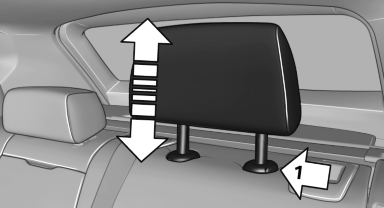
► To raise: pull.
► To lower: press the button, arrow 1, and
push the head restraint down.
The center head restraint cannot be adjusted in elevation.
Removing
Only remove the head restraint if no one will be sitting in the seat in question.
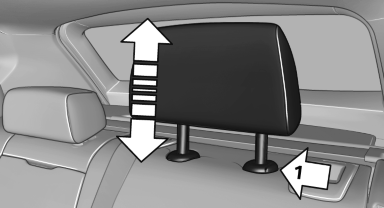
1. Pull the head restraint upward as far as possible.
2. Press the button, arrow 1, and pull the head
restraint out completely.
Before transporting passengers
Reinstall the head restraint before transporting
anyone in the seat; otherwise, the protective
function of the head restraint is unavailable.◄
See also:
Status field
The following information is displayed in the status
field at the top right:
► Time.
► Current entertainment source.
► Sound output, on/off.
► Wireless network reception ...
Switching on automatically
Select transmission position R with the engine
running.
The Top View and PDC images are displayed if
the system is switched on via iDrive. ...
General information
The sound settings are stored for the remote
control currently in use. ...